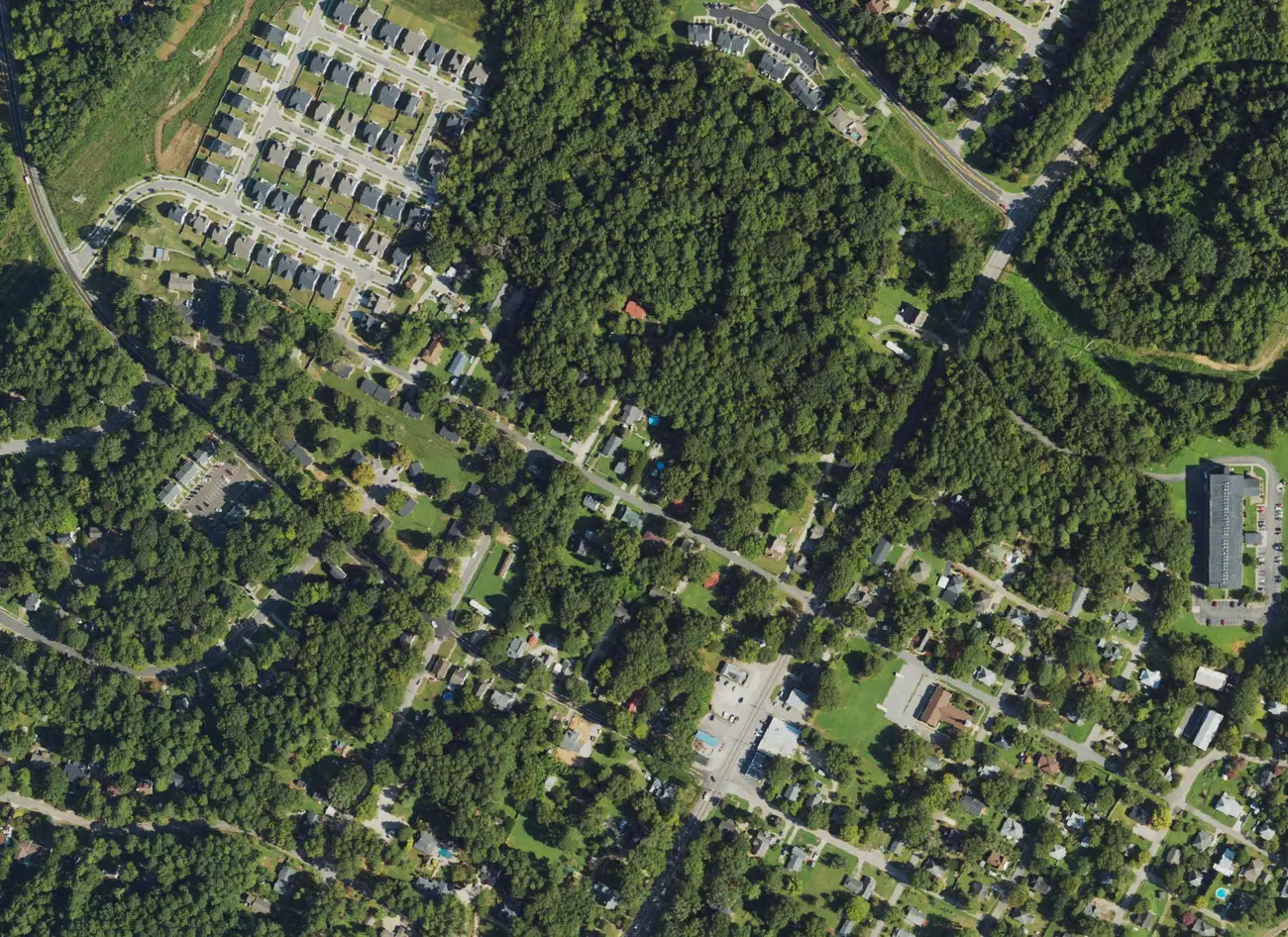
Glen Royall Mill Village, north of downtown Wake Forest, is a mill village built from 1900 and listed in 1999. Zoned for Wake Forest High; ZIP code 27587.
Last checked Oct. 12, 2026. Sources: the Town of Wake Forest’s historic districts page and map (PDF), the Wake County Public School System’s current base attendance areas, the N.C. Department of Public Instruction’s 2025-26 accountability data, OpenStreetMap and Zillow Research.
Glen Royall Mill Village is the neighborhood built for workers at the Glen Royall cotton mill, on the north side of Wake Forest above Oak Avenue. The town calls it one of the most intact mill villages in Wake County. Most of its original houses still stand, and its streets keep the layout they had when the mill ran.
What this means for you
- Zoned high school: Wake Forest High, 66.5% of state tests at grade level in 2025-26. Check an address with the district’s base school lookup.
- Home value: $508,282 in ZIP code 27587 in August 2026, according to the Zillow Home Value Index.
- Nearest U.S. 1 exit: Exit 125, N.C. 98 Business (Durham Road), about 3.1 miles by road.
Part of our Wake Forest neighborhoods guide.
Where it is
On the town’s historic districts map (PDF) the Glen Royall Mill Village Historic District lies northeast of North Main Street and Oak Avenue, taking in Mill Street, Water Avenue, Park Avenue, Hill Street and the north end of Wait Avenue. It borders the Wake Forest Historic District to the southwest; see our Historic District page. It is in ZIP code 27587.
History
The village was listed in the National Register of Historic Places on Aug. 27, 1999, with a period of significance from 1900 to 1949, the town’s historic districts page says. Construction of the mill and village began in 1900. The mill hired contractor Benjamin Thomas Hicks to build the houses to plans by the mill superintendent, John D. Briggs.
The typical house in the village is a four-room house with a pyramid-shaped roof and a central brick chimney, the town says. The mill ran until the 1970s, when a shift from cotton to synthetic fibers led to its closing in April 1976. The town says the village keeps its historic yard patterns and shade trees.
The town says National Register districts get some protection from projects that use federal or state money, and contributing properties may qualify for federal or state historic tax credits. More in our history and landmarks guide.
Schools
We checked 25 points in and around the village against the Wake County Public School System’s current base attendance areas.
| Level | School | Share of points | At grade level, 2025-26 | Growth |
|---|---|---|---|---|
| Elementary | Heritage Elementary | 88% | 78.0% | Exceeded |
| Elementary | Richland Creek Elementary | 12% | 73.4% | Met |
| Middle | Heritage Middle | 88% | 81.2% | Met |
| Middle | Wake Forest Middle | 12% | 52.5% | Not met |
| High | Wake Forest High | 100% | 66.5% | Exceeded |
“At grade level” is the share of state tests at grade level or above in the state’s 2025-26 accountability data; “growth” is whether students gained as much as the state expects in a year. Heritage Elementary and Heritage Middle are on Rogers Road, about 3 miles south, in the federal school directory. Check an address in the base school lookup. More in our schools guide.
Home values
The Zillow Home Value Index for ZIP code 27587, which covers all of Wake Forest, was $508,282 in August 2026, down 0.8% from $512,457 in August 2025. Zillow’s figure for the town was $507,240. The index is a modeled typical value for the middle third of homes, not a sale price, and it is not specific to the village. More in our home prices guide.
Parks and trails
- Flaherty Park, 1100 N. White St., east of the village: 100 acres with a community center, the town’s dog park, lighted tennis and pickleball courts, ball fields and two fishing ponds. See our parks and trails guide.
- Joey McCrea Wiggins Park, 416 N. Taylor St., to the south, with an accessible playground and a sprayground that reopened in June 2026.
Getting around
- U.S. 1 (Capital Boulevard): Exit 125, N.C. 98 Business (Durham Road), about 3.1 miles by road, and Exit 124, N.C. 98 (Dr. Calvin Jones Highway), about 4.8 miles. Exit numbers and names are from NCDOT’s interchange inventory.
- Downtown and Town Hall: about 1.3 miles by road.
- Raleigh-Durham International Airport: about 23 miles by road.
- Bus: no fixed bus route runs through the village. Go Wake Forest on-demand rides cover the town at 984-342-2319, and the WRX express to Raleigh leaves from downtown.
Distances are measured on the OpenStreetMap road network from the middle of the village; they are distances, not drive times. More in our getting around guide.
Groceries and everyday stores
From OpenStreetMap:
- Supermarkets: Harris Teeter and Lowes Foods, both on Capital Boulevard, a little over a mile west.
- Pharmacy: CVS Pharmacy, East Roosevelt Avenue, near downtown.
Frequently asked questions
What is Glen Royall Mill Village?
It is the village of houses built for workers at the Glen Royall cotton mill north of downtown Wake Forest, begun in 1900. It was listed in the National Register of Historic Places on Aug. 27, 1999, and the mill closed in April 1976, according to the town.
What schools is Glen Royall zoned for?
Every point we checked was zoned for Wake Forest High. About 88% were zoned for Heritage Elementary and Heritage Middle, and the rest for Richland Creek Elementary and Wake Forest Middle.
What ZIP code is Glen Royall in?
Glen Royall Mill Village is in ZIP code 27587, which covers all of Wake Forest.
What is the typical home value in Glen Royall?
Zillow does not publish a figure for the village. The Zillow Home Value Index for ZIP code 27587 was $508,282 in August 2026, down 0.8% from a year earlier.
Have your say