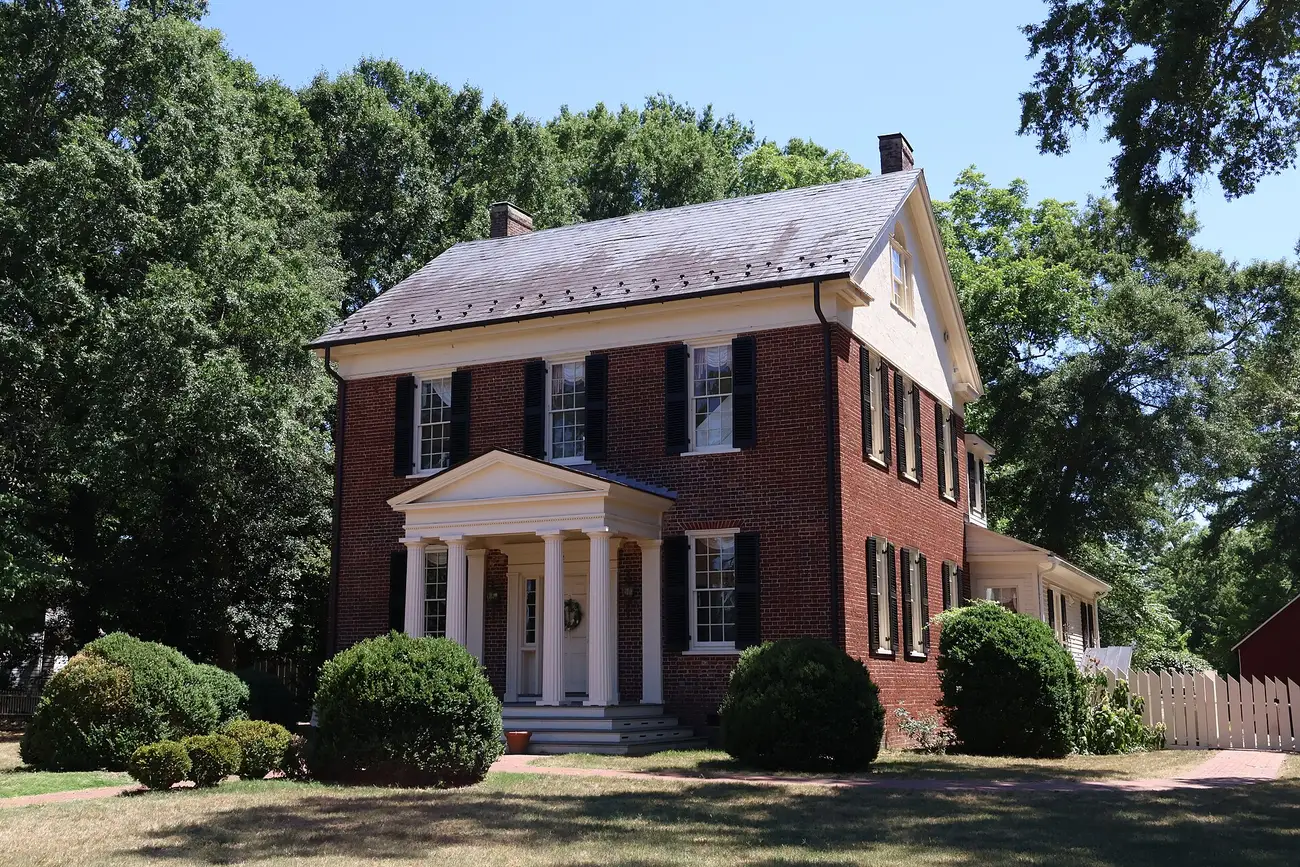
Wake Forest grew from the 1834 Baptist institute that became Wake Forest College. Incorporated 1880, rechartered 1909. Every National Register listing.
Last checked Oct. 12, 2026. Sources: the Town of Wake Forest’s history page, the North Carolina State Historic Preservation Office’s National Register listings and the Wake Forest Historical Museum.
Wake Forest began as a college town. In 1832 the North Carolina Baptist Convention bought Dr. Calvin Jones’ 615-acre plantation north of Forestville for $2,000, and Wake Forest Institute opened there in February 1834, the town’s history says. The community was incorporated on March 26, 1880, as the Town of Wake Forest College, and in 1909 the General Assembly rechartered it as the Town of Wake Forest. The Wake Forest Historical Museum, 414 N. Main St., is free; call 919-556-2911.
Who to call
- Wake Forest Historical Museum: 919-556-2911, 414 N. Main St.
- Historic district rules (Historic Preservation Commission): Wake Forest Planning Department, 919-435-9510, historic preservation page
- Wake Forest Cemetery: Public Works, 919-435-9570
How Wake Forest grew
From the town’s history page, unless noted:
- 1823: Calvin Jones becomes the area’s postmaster and heads his letters “Wake Forest,” joining Wake County, created in 1771, with the Forest District, named in 1805.
- 1832: The Baptist Convention buys the Jones plantation to found a school for future ministers.
- 1834: Wake Forest Institute opens in February; 72 students enroll in its first year.
- 1835 to 1838: Architect John Berry builds Wait Hall and two professors’ homes, the North and South Brick Houses.
- 1838: The school is rechartered as Wake Forest College.
- 1839: The college sells 80 one-acre lots north of campus. Their main street, Faculty Avenue, is now most of the Wake Forest Historic District.
- 1840: The Raleigh & Gaston Railroad reaches the east side of campus.
- 1862 to 1865: The college closes for the Civil War; Wait Hall serves as a hospital.
- 1874: The college pays $2,000.03 to move the depot from Forestville, and stores rise on White Street.
- March 26, 1880: Incorporated as the Town of Wake Forest College.
- 1899: Royall Cotton Mill, the town’s first industry, opens north of town.
- 1909: Rechartered as the Town of Wake Forest.
- 1933 and 1936: Wait Hall burns; the North Brick House is torn down.
- 1952: U.S. 1 is moved west of town.
- 1956: The college finishes its move to Winston-Salem; Southeastern Baptist Theological Seminary keeps the campus.
National Register of Historic Places
The state historic preservation office lists these places, with the date each was listed. Its listing page links each nomination.
In Wake Forest
| Place | Listed |
|---|---|
| Lea Laboratory | May 29, 1975 |
| Forestville Baptist Church | Oct. 25, 1984 |
| Royall Cotton Mill Commissary | Oct. 16, 1991 |
| W.E.B. DuBois School | Oct. 5, 1993 |
| Glen Royall Mill Village Historic District | Aug. 27, 1999 |
| Downtown Wake Forest Historic District | Feb. 20, 2002 |
| Wake Forest Historic District | Dec. 18, 2003 |
| Purefoy-Chappell House and Outbuildings | Oct. 22, 2008 |
| South Brick House | May 27, 2014 |
| Dr. Calvin Jones House | Dec. 20, 2016 |
| William and Barbara Mutschler House | April 20, 2023 |
In the Wake Forest vicinity
| Place | Listed |
|---|---|
| Wakefields (Home Acres) | Oct. 6, 1974 |
| Powell House | Oct. 15, 1974 |
| Purefoy-Dunn Plantation | March 24, 1988 |
| William Thompson House | Sept. 15, 2005 |
| Rock Cliff Farm | Aug. 29, 2007 |
Most are private homes; view them from the street.
Museums, markers and cemeteries to visit
- Wake Forest Historical Museum and Calvin Jones House, 414 N. Main St. Free. Open 10 a.m. to 4 p.m. Tuesday through Sunday; closed Mondays. Self-guided tours of the Jones house, where his family lived from 1821 to 1832, run Tuesday through Sunday, with guided tours at 2 p.m. Friday through Sunday. Park off Juniper Avenue behind the museum, its visit page says. The museum also leads monthly walking tours.
- Ailey Young House, 300 block of North White Street. Built about 1875 and owned by the town, it may be the oldest remaining African American building in Wake Forest. It is a local historic landmark and on the state’s Study List, according to the town.
- Historic markers: the Historic Preservation Commission unveiled markers in June 2026 for Oscar Alston’s barber shop, 111 S. White St., and W.E.B. DuBois High School, 536 N. Franklin St., built in 1926 with Rosenwald Fund money, the museum reported.
- Wake Forest Cemetery, 400 N. White St., maintained by the town. Its cemetery page links a list of notable burials and a virtual tour. Plots are sold out.
What this means for you
- Start at the museum: it is free six days a week.
- Own a home in a local historic district? Check with the Planning Department before exterior work.
- More local guides: parks and trails and population and growth.
Frequently asked questions
When was Wake Forest, North Carolina, founded?
The town grew around Wake Forest Institute, which the North Carolina Baptist Convention opened in February 1834 on land it bought in 1832. The community was incorporated on March 26, 1880, as the Town of Wake Forest College and rechartered as the Town of Wake Forest in 1909.
How did Wake Forest get its name?
Dr. Calvin Jones, who owned the 615-acre plantation the town stands on, became the area’s postmaster in 1823 and headed his letters Wake Forest, combining Wake County and the area’s Forest District, according to the town.
Is Wake Forest University still in Wake Forest?
No. After World War II the college announced it would move to Winston-Salem, and it left in 1956. Southeastern Baptist Theological Seminary now occupies the old campus.
Is the Wake Forest Historical Museum free?
Yes. The museum at 414 N. Main St. is free and open 10 a.m. to 4 p.m. Tuesday through Sunday; it is closed Mondays. Guided tours of the Calvin Jones House are at 2 p.m. Friday through Sunday.
How many National Register of Historic Places listings are in Wake Forest?
The state historic preservation office lists 11 properties and districts in Wake Forest itself and five more in the Wake Forest vicinity, from Powell House in 1974 to the William and Barbara Mutschler House in 2023.
Have your say